Showing posts with label Post Modernism. Show all posts

Sunday, November 4, 2012

Inspiring Icons/ Michael Graves

Left: Detail of his famous Alessi kettle, Right: A portrait drawn by Pablo Riestra

Some Of Graves best known consumer products, including some kettles, french press, pitcher and kitchen timer


Left: Some of Graves silhouettes including a tray, toaster and salt shaker Right: Portland Building, 1982
Left: Portrait of Michael Graves in 1990, Right: His famous kettle for Alessi

Some consumer cleaning products produced for Target

Left: The Big Dripper, designed in 1995, Right: One of Graves sketches

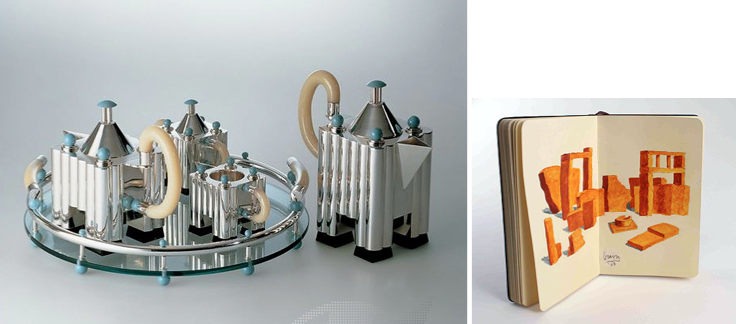
Left: The amazing Coffee and Tea set that mimic an Art Deco quality and the  buildings Graves creates, It was called the Coffee and Tea Piazza project, 1981, This was the start of Graves collaboration with Alessi
Right: Graves sketchbook
Left: The Thomson Consumer Electronics Headquarters, Indiana, 1992-94 (Now St. Vincent Health)
Right: The Steinberger Hotel at El Gouna, Egypt

Left: Architectural drawing for a Graves building, Right: Toaster designed by Graves

Left: Residence designed by Graves, Right: St Mary's Church of Rockledge, Florida, 2002

Left: I recently found this rare Alessi Euclid Thermos Pitcher, 1998, designed by Graves in a NY Flea Market,
It spurned the whole interest in me to further explore his work
Right: Interior of The Thomson Consumer Electronics Headquarters, Indiana, 1992-94


I remember when I was in Design School in the 90’s, There was much discussion about Post Modernism as a movement, A very famous and now sadly deceased Architect Harry Seidler actually came to my University and gave a speech about the negative effects of Post Modernism on Modern Architecture. Of course I regarded him as a master and always harbored his influence on my own impressions even to this day, when it came to Design, He was a Purest and to a large extent I have thought of myself deep down as one too. He had an obvious dislike of new Architecture of the time but it seemed inevitable at the time that this change was going to be part of Architectural history, even if he did not like it.

At the time, you could not ignore the influence of this new movement that had sprung up and it’s overpowering impact on new architecture, something that Sydney at the time was experiencing in a lot of its new redevelopment urban projects such as Darling Harbour. Of course that was my world at the time, but Post Modernism was happening all over the world.

One Architect whose influence has been without doubt amazingly influential is Michael Graves. He is regarded by many as the Post Modernism king. Identified as one of The New York Five, Graves has become a household name with his designs for domestic products sold at Target stores in the United States.  

In American Design and Culture Graves influence is phenomenal, he has designed more than 2,000 consumer products - from toasters to watches to ironing boards - that were sold exclusively at Target stores. The famous pairing in it’s day helped give Target a reputation for cheap chic that distinguished it from discount-store rivals like Walmart and Kmart. They have just parted ways this year, Some people may argue that his designs seem bulbous and almost cartoon like, but my impression is that while I maybe a purest at heart who skews towards a more International style, Graves has contributed a legacy and dedication to design that is admirable and very distinctive, His work has a sense of whimsy and humor and extreme relevance to an era that I grew up with and still continues to dot our skylines, his work and many other Post Modernism works still form the mesh of current landscapes.  

His amazing work for Target aside, his most well known work for me is his work for Alessi, The Italian company that were leaders in promoting Post Modernism style and much sought after at that time. My Aunty and Uncle were the first I knew to have a complete set of Michael Graves Alessi and as a child I always envied them compared to my parents more traditional tea and coffee set. They were sought after collector pieces and still are. They came about following the successful collaboration on the Coffee and Tea Piazza in 1981. As a result, Alberto Alessi asked Graves to design a teakettle that would heat quickly, necessitating a wide base. An arcing handle with a colorful blue insulator balances the conical shape of the kettle. The addition of the whistling bird, a reference to the red Indiana roosters familiar to him in his youth, was Graves's nod to his Midwestern roots. The first product by an American designer to be included in the Alessi catalogue, Graves's playful teakettle became an immediate design icon. In continuous production since 1985. Tea and Coffee themes became a staple of Graves work and you can see many of his most famous consumer products are for this purpose.

Michael Graves continues to work out of his practice in New Jersey and on major International and U.S projects, Check out his work at michaelgraves.com

Saturday, December 17, 2011

Italian's do it Better/ Ettore Sottsass

Ettore Sosstass in 2006, photographed by J.Emilio Flores, His famous Memphis piece

Vases for Bisotti designed by Ettore Sottsass


Totem series designed by Ettore Sottsass

Totem series designed by Ettore Sottsass

Memphis piece and Enorme Telephone designed by Ettore Sottsass

Memphis piece, Vase and Olivetti typewriter by Ettore Sottsass

Vases and Vessels by Ettore Sottsass

Memphis pieces by Ettore Sottsass

Memphis pieces by Ettore Sottsass

Vases by Ettore Sottsass

Enamel plates by Ettore Sottsass

Sketches/ Designs by Ettore Sottsass

Sketches/ Designs by Ettore Sottsass
It was in the 1990’s a part of my Design Degree that I first studied quite intensively the Post Modern Movement, In the 90’s we were actually still really going through it and some would argue we still are, Post Modernism refers to a point of departure for works of literature, drama, architecture, cinema, journalism, and design. The movement of Postmodernism really began with architecture, as a response to the perceived blandness, hostility, and Utopianism of the Modern movement. Modernist Ludwig Mies van der Rohe is associated with the phrase "less is more"; in contrast Post Modernists say, "Less is a bore."

The 1980’s was such a powerful decade in the way when we look back but in the minimalist 1990’s we almost looked at this work in shock and horror, It was too close to appreciate. The 1980’s had been so radical, in the 1990’s we came out of the 80’s a bit shell shocked and dazed by it’s boldness and tenacity. At school I remember studying the work in particular of Ettore Sottsass (1917-2007) who was the famous Italian architect, designer and leader of the Post Modernism movement. In the height of it in 1981, Sottsass and an international group of young architects and designers had come together to form the Memphis Group. Memphis was launched with a collection of 40 pieces of furniture, ceramics, lighting, glass and textiles, which featured fluorescent colors, slick surfaces, intentionally lop-sided shapes and squiggly laminate patterns. It hit the marketplace with such force that it influenced the design of that decade on so many levels.

The interesting thing with Sottsass’s work is that although his work hit the mainstream in the 1980’s and is remembered so vividly with being connected with Memphis and seems so iconic with that era, his work right back to the 1950’s still holds the same vision, playfulness and life. I have recently been re connecting with that work, Here on this post I am sharing his range of totems, vases and enamel plates that he developed much earlier than the1980’s I think they are pure genius in their use of colors compositions and form.  

Sottsass was truly a giant of Design, as said by Paola Antonelli, the senior curator in the Museum of Modern Art’s department of architecture and design. “He had a capacity to really feel the times that he was living in and to change with them.”