Showing posts with label Inspiring Icons. Show all posts

Sunday, July 12, 2015

Inspiring Icons/ Paul McCobb

Left: Tables designed by Paul McCobb for Furnwood Corp, 1950's, Right: Portrait of Paul McCobb C1950's

A collection of credenzas designed by Paul McCobb, 1950's-1960's

A collection of Paul McCobb designs including his famous wooden chair, cabinets, lights and sofa's


Left: Dining chair by Paul McCobb C 1950's, Right: Shelving and High back windsor chair


Left: Advert for Paul McCobb, C 1950's, Right: Modern day setting including a Paul McCobb credenza

Left: Shelving system designed by Paul McCobb, C 1950's in an original photograph.
Right: Various pieces including coffee cups, teapot, tiles and office desk organiser

Left: Pitcher in ceramic, planter and room setting all designed by Paul McCobb,
Right: Another Advert promoting Paul Mc Cobb Designs, C 1950's


Paul McCobb is one of those influential designers that seem to have slipped under the radar, Most people in design circles in the States know and admire his work and he is highly collectible but unlike some of the other design superstars like George Nelson, Florence Knoll and The Eames of that era, Paul McCobb seems to have gained slightly less attention. His work combined the attributes of many of his now better-known peers. Like Bauhaus designers such as Ludwig Mies van der Rohe and Marcel Breuer, his furniture had purity of form and line. Like his fellow designer’s of that era, McCobb’s work was efficient and purposeful.


McCobb was born in Medford, Massachusetts, Young and artistic, McCobb studied art, drawing and painting at the Vesper George School of Art in Boston but not completing his course there. McCobb enlisted in the Army in 1942 also in Boston but only served in the military for a year.

McCobb first gained attention in 1948 as a design and decorating consultant for Modernage Furniture in NY. While employed at Modernage, McCobb met B.G Mesberg, his later business partner in the Planner and Directional furniture lines. Other well-known furniture lines designed by McCobb include Predictor by O'Hearn Furniture, The Irwin Group by Calvin Furniture, The Connoisseur Collection by H. Sacks & Sons and The Calvin Group by Calvin Furniture which is our favorite line here at Studio Marcus Hay.


He is also well known for his ceramics line and helped, alongside Russel Wright to introduce high design to the mainstream.


Thanks to the guys at JustL in New Hampshire, We recently purchased a fantastic piece, a maple and leatherette credenza designed by McCobb for the Calvin Group and it now proudly houses our ever growing LP collection, It brought to the room an instant elevated sense of sophistication and unity, We simply love it! Mccobb’s pieces mix in seamlessly with other contemporary furniture, the simple classic lines and great materials and craftsmanship can be admired for years. 


These layouts were designed by Studio Marcus Hay, Inc for the educational purposes of promoting McCobbs work on this blog only, We will happily credit any known photographs. 

Wednesday, March 18, 2015

Inspiring Icon/ Massimo Vignelli

Left: Portrait Of Massimo, Right: His signature signature

Massimo's logo's for American Airlines

Massimo's logo's for Bloomingdales

Massimo's Perpetual Wall calendar for Nava Milano, 1980

His designs for Heller, including both product and packaging/ logo

Further designs for Heller

Left: Benches designed by Massimo for Heller, Right: The Knoll International poster

Left: poster for Pirelli, Right: More designs for Heller 

Left: Stendig Calendar, Right: Poster for Massimo's company 

Left: Pitchers designed by Lella and Massimo for Venini, Right: Table

Left: The NY Subway map, Right: Poster designed by Massimo

Left: Poltronova Saratoga furniture systems, Right: Lighting designed by Lella and Massimo

Left: Handkerchief chair for Knoll, Right: Paperclip table for Knoll

Logo's for both Ford and United Colors of Benetton

Left: Signage for the NY Subway, Right: His own poster


When you live in New York as I do, you see the influence of Massimo Vignelli everywhere from shopping bags to the subway, Coming up to a years anniversary of his death in May at the age of 83, I think we should never forget the layer and strength of design that he bought to the industry as a whole.
Massimo Vignelli, a world acclaimed graphic designer and architect whose Modernist aesthetic reached the masses without them even realizing, he focused on simplicity through the use of basic geometric forms in all his work. A fan of the architects Mies van der Rohe and Le Corbusier, Massimo moved to New York from Italy in the mid 60’s as many do to fufil a dream of instigating functional beauty and change through design and boy did he do it! He introduced a European modernist point of view to the streets of New York and beyond.
His clients included American Airlines, Ford, IBM, Xerox and Gillette, Bloomingdale’s, Pirelli, Heller, Knoll, Benetton, Saks Fifth Avenue and Barneys, He is best known for designing the signs for the New York and Washington subways.
Massimo Vignelli and his wife Lella founded their own firm, Vignelli Associates, in 1971 in New York. It became Vignelli Designs in 1978. Lella Vignelli alongside her husband, managing the business and helping with design, they were a force together. Starting as a Graphic Design business they ventured quickly into interior, furniture and also product design. I love his range he did for Heller and many of his own furniture designs for Knoll. 
As one of the major figures in Modernism Massimo had an illustrious career spanning nine decades, I love the fact that his work remains as fresh and inspiring as the day it was brought in fruition, the hallmark of a exceptional visionary. He is one of our main influences and that's why we consider him and inspiring icon 

Wednesday, July 31, 2013

Inspiring Icons/ Piero Fornasetti

Right: Portrait of Fornasetti, Left: Screen Design


Right: Portrait of Fornasetti, c/o Rizzoli.com, Left: The mark of Fornasetti

Right, Bookends, Left: Cabinet Design, Current  Fornasetti products

Various current  Fornasetti products

Various Designs using lip motif

Right: Fornasetti Plates, Photo by Graham Moss, Left: Cabinet Design

A man of many cabinets, Cabinet Designs

Right: Ice bucket Design, Left: Stationary Holder Design

Right: Cabinet Design with Sun Motif, Left: Screen Design

Fornasetti at Home,  Photo: www.fornasetti.com

Fornasetti at Home,  Photo: www.fornasetti.com

Fornasetti at Home,  Photo: www.fornasetti.com

Right: At Home, Left: Detail Inside the Studio, Photo: www.fornasetti.com

Inside the Studio, Photo: www.fornasetti.com

Left: Cabinet design, Right: Inside the Studio, Photo: www.fornasetti.com

One of my favorite designers of all time, Piero Fornasetti’s volume of work is so extensive it blows my mind, Largely known for his work on Tema e Variazioni plates, His work is just so much more than these wonderful plates.
Piero Fornasetti lived and worked in Milan, Italy and was known as a painter, sculptor, interior decorator, engraver of books and a creator of more than 11,000 products. In fact in terms of variety of decoration, Fornasetti’s production of objects and furniture is one of the largest of the 20th century.
Fornasetti is celebrated as being among the most original creative talents of the twentieth century. During his career he created a visual vocabulary that is instantly recognisable and unceasingly engaging. Fornasetti designed a magical world, saturated in image and color and filled with whimsy and wit.

An amazing website with a interactive feel, www.fornasetti.com is feast for the eyes, Many of these images on this post are from this site, One set of images I love in particular is the tour of his house, where you get to scan across and see wide format images that capture every detail including Fornasetti himself interacting with the space, His house can be found in the Città Studi area of Milan, I would love to visit it today, I wonder if it is still intact? There is no better, certainly no richer, example of the Fornasetti aesthetic.
Fornasetti’s son, Barnaba, is perpetuating the Fornasetti tradition by continuing to produce, and revive, Fornasetti designs. My hat is off to him, I just love seeing the original and the interpretations, The spirit of Fornasetti must be kept alive. 
Most of the images are from my folder in my Furniture I love folder on  Pintrest, Unfortunately I can't find evidence of who photographed these images, Any person needing credit please be in touch for me to include your credit if desired. 

Friday, April 12, 2013

Inspiring Icons/ Donald Judd


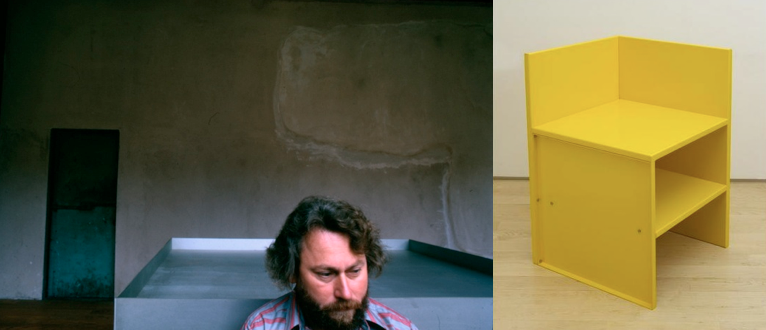
Left: Donald Judd, Shot by Arnold Newman, 1973, Right: Chair
Left: Donald Judd sketch, Right: Chair


Left: Installation, Right: Chair


Left to right: Installation, Chairs, Installation

Left: Installation,  Right: Poster for 1970's exhibition, Leo Castelli, NYC

Left: Studio in Marfa, Texas, Right: Chair

Left: Blue Bookcase, Right: Installation


left: Installation, Right: Print


left: Exterior Installation, Marfa, Texas, Right: Japanese Poster


Donald Judd (1928-1994) did not really want to be known as a minimalist, nobody really likes to be branded I suppose? However he has been associated with that movement. Many would not know this but while I love the layer of objects, my core has always been an appreciation of minimalism. I have always loved the clean and uncomplicated lines of Judd’s work in all mediums. His work in sculpture and furniture is most known

Wikipedia says Judd sought autonomy and clarity for the constructed object and the space created by it, ultimately achieving a rigorously democratic presentation without compositional hierarchy. What does this all mean one might ask, I think largely it is saying that Judd’s work was so purposeful and executed with such vision and determination that his stamp is simply seen without any confusion throughout all his work. It’s a purity that is spell bounding!

To have this vision and for it to resonate with such strong conviction is something as Artists we all strive for, no matter what profession.

Donald spent much of his life and career in New York City where in the late 1960’s he bought a five-story building that allowed him to start placing his work in a more permanent manner than was possible in gallery or museum shows. Over the next 25 years, Judd renovated the building floor by floor, sometimes installing works he purchased or commissioned from other artists.

In 1979 Judd purchased desert land near Marfa, Texas, The first furniture was designed in 1973, when he moved from New York to Marfa. Early furniture was made of rough pine but Judd continually refined the construction. Later he worked in sheet metal. The pieces included chairs, beds, shelves, desks and tables. Desk and Chair (both 1984), made of clear anodised aluminium and copper respectively, demonstrate Judd’s move from hand-crafted forms to embracing methods of industrial manufacture.

You can read more about Donald Judd or purchase some of his furniture at   www.artwareeditions.com or check out www.juddfoundation.org

All photo's credited where possible.